Wall Street Journal had an interesting piece today where they discuss how the "clash that pits [European] governments against the new tech titans, established industries against upstart challengers, and freewheeling American business culture against a more regulated European framework". For example, "[t]he European Parliament in late October called on Internet companies operating in the region to “unbundle” its search engines from its other commercial properties". The obvious company that would be impacted by this is Google (and the WSJ article notes that Microsoft is aiding and abetting such calls to help boost its own profile).
However, the WSJ article notes: "And perhaps most fundamentally, it is about control of the Internet, the world’s common connection and crucial economic engine that is viewed as being under the sway of the U.S. This exploded following the revelations by Edward Snowden of widespread U.S. government surveillance of Americans and Europeans—sometimes via U.S. company data and telecommunications networks."
This would not be the first article to note that the Snowden revelations have put a chill on the move to the (US) cloud. However, it does highlight how far the revelations have gone to force the hand of European regulators to at least act in public like they are trying to do something to protect the data of their companies.
What the article did not into much detail is the likely reason that the Europeans are concerned. Although it may presented to be an issue of privacy or anti-surveillance, the likely real reason is industrial espionage. As per the Snowden revelations, governmental spy agencies are not
just interested in obtaining information on matters relating to national
security, but are also interested in obtaining data related to international
trade or other business dealings. As noted by the CBC, “NSA does not limit itsespionage to issues of national security and he cited German engineering firm,Siemens as one target”. It is unfair just to single out the US for such actions, as other governments do it as well. For example, Canada’s CSEC is also alleged to be involved in similar activity. The Globe & Mail reporting that “Communications SecurityEstablishment Canada (CSEC) has spied on computers and smartphones affiliatedwith Brazil’s mining and energy ministry in a bid to gain economic intelligence.” Former Carleton University Professor Martin Rudner explains (in the same G&M article) that the objective
of such surveillance is to give Canadian government a leg up during
negotiations, such as NAFTA.
Although most have forgotten the commercial rivalries (see quote from then US president Woodrow Wilson about the roots of international conflict) that exist between the G8 Nations, it is important to understand the implications that this has for data security on the cloud. Anything that is sensitive and is relevant to business dealings should never be put on the cloud. Of course it is a matter of judgment of what constitutes "sensitive", but the criteria can effectively "reverse engineered" based on what was revealed.
Tuesday, December 9, 2014


Friday, December 5, 2014
Remembering those Blackberry days
The Globe and Mail reported on BlackBerry's latest approach in terms of rebuilding its mobile user base. The company is offering $400 trade + a $150 gift card for anyone who trades in their iPhone for the rather odd square shaped Passport. Here is the review from the Verge regarding the latest:
Coincidentally, I came across an BlackBerry of mine: the Torch. I remembered thinking that after using the device how it was the perfect compromise between the touch screen and the classic keyboard. However, that feeling faded quite quickly: the device was so under-powered compared to the competition and of course it lacked the apps that you could find in the Apple AppStore. But at the time I could never imagine giving up the physical QWERTY keyboard.
Since then I have moved onto Android and more specifically to the SwiftKey keyboard - to the point I can't go back to a physical keyboard!
How did BlackBerry fail to keep up with the times?
As noted in this article, Mike Lazaridis the founder of the CEO, was inspired to develop the BlackBerry when he recalled his teacher's advice while watching a presentation in 1987 - almost a decade before the Internet - on how Coke used wireless technology to manage the inventory at the vending machines. What was his teacher's advice? His teacher advised him not to get swept in the computer craze as the real boon lay in integrating wireless technology with computers.
BlackBerry caused a storm in the corporate introducing it's smartphones in 1998. It went on to dominate the corporate smartphone market as the gold standard in mobile communications. The following graphic from Bloomberg really captures the subsequent rise and fall quite well:
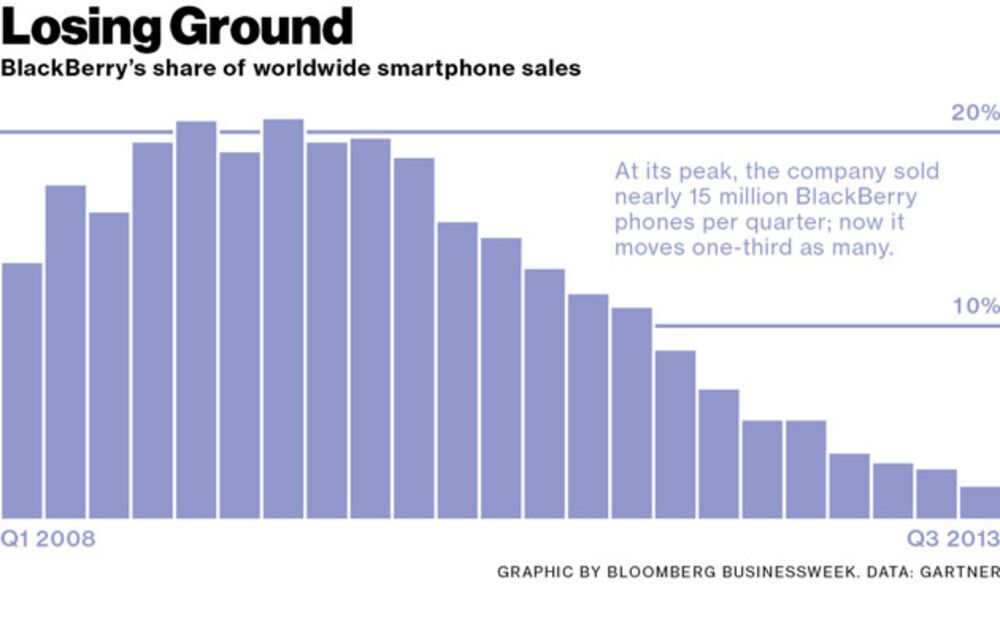 What happened how did the iPhone, unveiled in 2007, and the Android Operating System outflank the Blackberry? This article in the New Yorker larger blames BlackBerry's inability to understand the trend of "consumerization of IT": users wanted to use their latest iPhone or Android device instead of the BlackBerry in the corporate environment - and was it just a matter of technology to make this happen.
Although luminaries, such as Clay Christensen, have written extensively on the challenge of innovation. And there's always the problem of hindsight bias. However, is the problem more basic? When we look at the financial crisis, some people like to blame poor modeling. But I think that is more convenient than accepting the reality that people got swept up in the wave.
Isn’t it fair to say that people knew that house of cards was going to come down (and some of the investment banks were even betting on it falling apart), but were overly optimistic that they would get out before everyone else does?
But that’s the point.
When we are in a situation where we are surrounded by people who confirm our understanding of the world – we may believe them instead of trying to see if our understanding of the situation is correct. With the housing bubble, the key players wanted to believe that those models were correct – even though models have failed the infamous Long Term Capital Management. With BlackBerry what was it? Did they think their hold over the corporate IT? What I wonder is did they not even try to see within their families and those around them who were using the iPhone or Android devices? Weren’t they curious what “all the fuss was about”?
Although this is problem with many of us who want to believe that the present situation is going to continue indefinitely (especially when things are going our way), there are others who do stay on top of things. Most notably is the Encyclopedia Britannica that actually stopped issuing physical encyclopedias and moved to the digital channel instead.
Change is a challenge, but the key is to be prepared to admit that the current way of doing things can be done better, faster and in radically different way.
Coincidentally, I came across an BlackBerry of mine: the Torch. I remembered thinking that after using the device how it was the perfect compromise between the touch screen and the classic keyboard. However, that feeling faded quite quickly: the device was so under-powered compared to the competition and of course it lacked the apps that you could find in the Apple AppStore. But at the time I could never imagine giving up the physical QWERTY keyboard.
Since then I have moved onto Android and more specifically to the SwiftKey keyboard - to the point I can't go back to a physical keyboard!
How did BlackBerry fail to keep up with the times?
As noted in this article, Mike Lazaridis the founder of the CEO, was inspired to develop the BlackBerry when he recalled his teacher's advice while watching a presentation in 1987 - almost a decade before the Internet - on how Coke used wireless technology to manage the inventory at the vending machines. What was his teacher's advice? His teacher advised him not to get swept in the computer craze as the real boon lay in integrating wireless technology with computers.
BlackBerry caused a storm in the corporate introducing it's smartphones in 1998. It went on to dominate the corporate smartphone market as the gold standard in mobile communications. The following graphic from Bloomberg really captures the subsequent rise and fall quite well:
Although luminaries, such as Clay Christensen, have written extensively on the challenge of innovation. And there's always the problem of hindsight bias. However, is the problem more basic? When we look at the financial crisis, some people like to blame poor modeling. But I think that is more convenient than accepting the reality that people got swept up in the wave.
Isn’t it fair to say that people knew that house of cards was going to come down (and some of the investment banks were even betting on it falling apart), but were overly optimistic that they would get out before everyone else does?
But that’s the point.
When we are in a situation where we are surrounded by people who confirm our understanding of the world – we may believe them instead of trying to see if our understanding of the situation is correct. With the housing bubble, the key players wanted to believe that those models were correct – even though models have failed the infamous Long Term Capital Management. With BlackBerry what was it? Did they think their hold over the corporate IT? What I wonder is did they not even try to see within their families and those around them who were using the iPhone or Android devices? Weren’t they curious what “all the fuss was about”?
Although this is problem with many of us who want to believe that the present situation is going to continue indefinitely (especially when things are going our way), there are others who do stay on top of things. Most notably is the Encyclopedia Britannica that actually stopped issuing physical encyclopedias and moved to the digital channel instead.
Change is a challenge, but the key is to be prepared to admit that the current way of doing things can be done better, faster and in radically different way.
Tuesday, October 28, 2014
Financial Crisis: Why didn't they use analytics?
For the past while, I have been reviewing the aftermath of the 2007-2008 Financial Crisis. I came across an interesting piece that highlights the importance of using analytics and "dashboarding" to monitor risk within a company. To be specific, I came across this when going through Nomi Prins's book, It Takes a Pillage: An Epic Tale of Power, Deceit, and Untold Trillions. Nomi Prins was in charge of analytics at Goldman Sachs and other banks. The embedded video gives more information about her and the book she wrote:
While listening to her book, I came across a transcript from the hearings in the aftermath of the crisis. As can be seen in the following video, Representative Paul E. Kanjorski is questioning the now-former CEO of Country Wide financial, Angelo Mozilo about the sub-prime crisis.
The part to focus on is where he grills the CEO about why they didn't aggregate statistics to monitor the mounting losses from the sub-prime loans (click here for where the transcript was extracted from. Please note the italics and bold is mine):
"Mr. Kanjorski: How long did it take you to come up with the understanding that there was this type of an 18 percent failure rate before you sent the word down the line, "Check all of these loans or future loans for these characteristics so we don't have this horrendous failure?"
Mr. Mozilo. Yes, immediately--within the first--if we don't get payment the first month, we're contacting the borrower. And
that's part of what we do. And we are adjusting our----
Mr. Kanjorski. I understand you do to the mortgage holder. But don't you put all those together in statistics and say, "These packages we are selling now are failing at such a horrific rate that they'll never last and there will be total decimation of our business and of these mortgages?" "
In other word, the Congressman is wondering how the CEO could not know that his business was failings because it is only common sense to monitor the key metrics that measure the key risk indicators (KRIs) associated with his principal business activities.
I would be the first to argue that there was much bigger issues with the financial crisis, such as the 16 trillion dollar-bank-bailout, the failure to properly rate the bonds backed by the sub-prime mortgages, quantitative easing, and so on. That being said, organizations and companies need to be aware of the importance of measuring the KRIs associated with their business. Regulators, and others charged with oversight, will eventually question the insufficiency of such monitoring controls. Furthermore, as these regulators are more tech savvy - such as the judge in the Oracle vs Google trial - the more sophisticated dashboards they will expect.
While listening to her book, I came across a transcript from the hearings in the aftermath of the crisis. As can be seen in the following video, Representative Paul E. Kanjorski is questioning the now-former CEO of Country Wide financial, Angelo Mozilo about the sub-prime crisis.
The part to focus on is where he grills the CEO about why they didn't aggregate statistics to monitor the mounting losses from the sub-prime loans (click here for where the transcript was extracted from. Please note the italics and bold is mine):
"Mr. Kanjorski: How long did it take you to come up with the understanding that there was this type of an 18 percent failure rate before you sent the word down the line, "Check all of these loans or future loans for these characteristics so we don't have this horrendous failure?"
Mr. Mozilo. Yes, immediately--within the first--if we don't get payment the first month, we're contacting the borrower. And
that's part of what we do. And we are adjusting our----
Mr. Kanjorski. I understand you do to the mortgage holder. But don't you put all those together in statistics and say, "These packages we are selling now are failing at such a horrific rate that they'll never last and there will be total decimation of our business and of these mortgages?" "
In other word, the Congressman is wondering how the CEO could not know that his business was failings because it is only common sense to monitor the key metrics that measure the key risk indicators (KRIs) associated with his principal business activities.
I would be the first to argue that there was much bigger issues with the financial crisis, such as the 16 trillion dollar-bank-bailout, the failure to properly rate the bonds backed by the sub-prime mortgages, quantitative easing, and so on. That being said, organizations and companies need to be aware of the importance of measuring the KRIs associated with their business. Regulators, and others charged with oversight, will eventually question the insufficiency of such monitoring controls. Furthermore, as these regulators are more tech savvy - such as the judge in the Oracle vs Google trial - the more sophisticated dashboards they will expect.
Wednesday, August 6, 2014
Worth mentioning: KPMG's take on the state of tech in the audit profession
In a recent post (as in just this week) on Forbes, KPMG's James P. Liddy who is the Vice Chair, Audit and Regional Head of Audit, Americas put out a great post that summarizes the current state of analytics in financial audits.
He diplomatically summarizes the current state of the financial audit as "unchanged for more than 80 years since the advent of the classic audit" while stating "[a]dvances in technology and the massive proliferation of available information have created a new landscape for financial reporting. With investors now having access to a seemingly unlimited breadth and depth of information, the need has never been greater for the audit process to evolve by providing deeper and more relevant insights about an organization’s financial condition and performance –while maintaining and continually improving audit quality." [Emphasis added]
For those that have started off our careers in the world of financial audit as professional accountants and then moved to the world of audit analytics or IT risk management, we have always felt that technology could help us to get audits done more efficiently and effectively.
I was actually surprised that he stated that auditors "perform procedures over a relatively small sample of transactions – as few as 30 or 40 – and extrapolate conclusions across a much broader set of data". We usually don't see this kind of openness when it comes to discussing the inner-workings of the profession. However, I think that discussing such fundamentals is inevitable given those outside the profession are embracing big data analytics in "non-financial audits". For example, see this post where I discuss the New York City fire department's use of big data analytics to identify a better audit population when it comes to identifying illegal conversions that are a high risk and need to be evacuated.
For those that take comfort in the regulated nature of the profession as protection of disruption, we should take note of how the regulators are embracing big data analytics. Firstly, the SEC is using RoboCop to better target financial irregularities. Secondly, according to the Wall Street Journal, FINRA is eyeing an automated audit approach to monitoring to risk. The program is known as "Comprehensive Automated Risk Data System" (CARDS). As per FINRA:
"CARDS program will increase FINRA's ability to protect the investing public by utilizing automated analytics on brokerage data to identify problematic sales practice activity. FINRA plans to analyze CARDS data before examining firms on site, thereby identifying risks earlier and shifting work away from the on-site exam process". In the same post, Susan Axelrod, FINRA's Executive Vice President of Regulatory Operations, is quoted as saying "The information collected through CARDS will allow FINRA to run analytics that identify potential "red flags" of sales practice misconduct and help us identify potential business conduct problems with firms, branches and registered representatives".
As a result, I agree with Mr. Libby: sticking to the status quo is no longer a viable strategy for the profession.
He diplomatically summarizes the current state of the financial audit as "unchanged for more than 80 years since the advent of the classic audit" while stating "[a]dvances in technology and the massive proliferation of available information have created a new landscape for financial reporting. With investors now having access to a seemingly unlimited breadth and depth of information, the need has never been greater for the audit process to evolve by providing deeper and more relevant insights about an organization’s financial condition and performance –while maintaining and continually improving audit quality." [Emphasis added]
For those that have started off our careers in the world of financial audit as professional accountants and then moved to the world of audit analytics or IT risk management, we have always felt that technology could help us to get audits done more efficiently and effectively.
I was actually surprised that he stated that auditors "perform procedures over a relatively small sample of transactions – as few as 30 or 40 – and extrapolate conclusions across a much broader set of data". We usually don't see this kind of openness when it comes to discussing the inner-workings of the profession. However, I think that discussing such fundamentals is inevitable given those outside the profession are embracing big data analytics in "non-financial audits". For example, see this post where I discuss the New York City fire department's use of big data analytics to identify a better audit population when it comes to identifying illegal conversions that are a high risk and need to be evacuated.
For those that take comfort in the regulated nature of the profession as protection of disruption, we should take note of how the regulators are embracing big data analytics. Firstly, the SEC is using RoboCop to better target financial irregularities. Secondly, according to the Wall Street Journal, FINRA is eyeing an automated audit approach to monitoring to risk. The program is known as "Comprehensive Automated Risk Data System" (CARDS). As per FINRA:
"CARDS program will increase FINRA's ability to protect the investing public by utilizing automated analytics on brokerage data to identify problematic sales practice activity. FINRA plans to analyze CARDS data before examining firms on site, thereby identifying risks earlier and shifting work away from the on-site exam process". In the same post, Susan Axelrod, FINRA's Executive Vice President of Regulatory Operations, is quoted as saying "The information collected through CARDS will allow FINRA to run analytics that identify potential "red flags" of sales practice misconduct and help us identify potential business conduct problems with firms, branches and registered representatives".
As a result, I agree with Mr. Libby: sticking to the status quo is no longer a viable strategy for the profession.
Tuesday, August 5, 2014
Had the Red Coats monitored Paul Revere's Facebook, would America be independent today?
The Globe and Mail reported that Canadian intelligence captures private data without a warrant in its fight against Chinese hackers. As one would expect, the article discusses how there is calculation performed to determine whether the harm of invading privacy of Canadians is outweighed by preserving national security.
The privacy debate ranges between two camps. One camp, such as EPIC, work to shed light on how organizations and governments encroach on individual privacy and see encroachment as a threat to the individual's ability to express ideas and the like. The other camp is the likes of Jeff Jarvis, a professor at CUNY and self-admitted-Google-fanboy-extraordinaire, who often defends Google's encroachment on the lives of people by slamming people's fear of Google by forcing his opponents to quantify "what's the harm". He especially takes issue with the emotional response of how of people feel that Google's knowledge of them is "creepy".
In a sense, I understand where Professor Jarvis is coming from: consumers want more customized services and they don't want to pay cash for them, so companies have to resort to advertising revenues to be paid. Google, Facebook, et al, are profit making companies and they want to be paid.
To me this is not the real cost in terms of privacy.
The real cost is how the government uses that data it gathers directly, or indirectly via Facebook (according to RT the mood study FB was performing was part of a gov't contract to deal with "civil unrest") , Google, et al, to interact with the politically objectionable.
One way to look at the cost is being spied upon, deemed a threat to national security and then sent somewhere to be tortured. This is what happened to Maher Arar. He was allegedly fingered by 15-year old Omar Khadr to be a terrorist. Based on this information, the US sent him to Syria to be tortured. According to the Garvie Report, the RCMP gave sensitive information about Arar to the US government. Ultimately, Arar was exonerated and all charges were cleared. The Canadian government paid him 10.5 million + legal fees and apologized to him. But how do you put a price on torturing an innocent man?
And to be sure democratic government do actively monitor the political active within the countries. For example, this article in the New York Times goes to describe in great detail how the government captured this information. Ultimately, Occupy was defeated through by police actions resulting in 8,000 arrests as well as other means. If it hadn't, how would the government have used this information to interact with the protesters on a go-forward basis?
From another perspective, the harm is also political engagement. Although the Maher Arar case shows that the government can mishandle the data it gathers about people and put them in harms way, this happens to a few people (e.g. Ahmad El Maati, Muayyed Nureddin and Abdullah Almalki) and is not a commonly used approach with dealing with protesters. For example, it's not like the Occupy protesters were rounded in the 1,000s and sent to Syria.
But there is another cost. Such surveillance and the potential for being harmed, puts a chilling effect for those that want to speak out against the way things are running. Why protest when you will lose your job and can't pay the bills? Think about the American War of Independence. If the British were able to spy on the "facebook" pages, email accounts and cell phones of Sam Adams, Paul Revere and pro-separatist sympathizers in the colonial militias - would the British had been able to arrest these separatists in a timely manner? Or would have pre-colonial surveillance society taught the Founding Fathers to self-censor and tow the pro-British line? It is pure speculation, but I think the Union Jack would still be flying in the land we now call America.
The privacy debate ranges between two camps. One camp, such as EPIC, work to shed light on how organizations and governments encroach on individual privacy and see encroachment as a threat to the individual's ability to express ideas and the like. The other camp is the likes of Jeff Jarvis, a professor at CUNY and self-admitted-Google-fanboy-extraordinaire, who often defends Google's encroachment on the lives of people by slamming people's fear of Google by forcing his opponents to quantify "what's the harm". He especially takes issue with the emotional response of how of people feel that Google's knowledge of them is "creepy".
In a sense, I understand where Professor Jarvis is coming from: consumers want more customized services and they don't want to pay cash for them, so companies have to resort to advertising revenues to be paid. Google, Facebook, et al, are profit making companies and they want to be paid.
To me this is not the real cost in terms of privacy.
The real cost is how the government uses that data it gathers directly, or indirectly via Facebook (according to RT the mood study FB was performing was part of a gov't contract to deal with "civil unrest") , Google, et al, to interact with the politically objectionable.
One way to look at the cost is being spied upon, deemed a threat to national security and then sent somewhere to be tortured. This is what happened to Maher Arar. He was allegedly fingered by 15-year old Omar Khadr to be a terrorist. Based on this information, the US sent him to Syria to be tortured. According to the Garvie Report, the RCMP gave sensitive information about Arar to the US government. Ultimately, Arar was exonerated and all charges were cleared. The Canadian government paid him 10.5 million + legal fees and apologized to him. But how do you put a price on torturing an innocent man?
And to be sure democratic government do actively monitor the political active within the countries. For example, this article in the New York Times goes to describe in great detail how the government captured this information. Ultimately, Occupy was defeated through by police actions resulting in 8,000 arrests as well as other means. If it hadn't, how would the government have used this information to interact with the protesters on a go-forward basis?
From another perspective, the harm is also political engagement. Although the Maher Arar case shows that the government can mishandle the data it gathers about people and put them in harms way, this happens to a few people (e.g. Ahmad El Maati, Muayyed Nureddin and Abdullah Almalki) and is not a commonly used approach with dealing with protesters. For example, it's not like the Occupy protesters were rounded in the 1,000s and sent to Syria.
But there is another cost. Such surveillance and the potential for being harmed, puts a chilling effect for those that want to speak out against the way things are running. Why protest when you will lose your job and can't pay the bills? Think about the American War of Independence. If the British were able to spy on the "facebook" pages, email accounts and cell phones of Sam Adams, Paul Revere and pro-separatist sympathizers in the colonial militias - would the British had been able to arrest these separatists in a timely manner? Or would have pre-colonial surveillance society taught the Founding Fathers to self-censor and tow the pro-British line? It is pure speculation, but I think the Union Jack would still be flying in the land we now call America.
Wednesday, July 30, 2014
Will "data lakes" cure companies info management problems?
Anyone working in the analytics space will know that one of the primary obstacles to performing analytics is the state of the underlying data. One may, naively, expect that organizations would see systems as a strategic asset that requires top attention. The reality is that the state of systems is much to be desired. This phenomenon was actually highlighted in Michael Lewis's latest book: Flash Boys. He notes in this interview, that his investigation into High Frequency Trading (HFT) began with the arrest of Sergey Aleynikov:
Aleynikov was arrested for stealing code from Goldman Sachs related to its HFT platform and it was assumed that he would use this code at his new employers trading department. However, as Lewis explains, the new firm used a totally different code base and the information he took was the equivalent of the notes one keeps in their notebook (Lewis explains that this was the judgement of Aleynikov's programming peers).
So if this is relatively useless information, why was Aleynikov kept in jail for a year?
The theory is that Goldman was afraid that the inadequacy of the HFT platform would be revealed to the world. Yes. Goldman. A bank deemed "too big too fail" - thereby having access to unlimited government funding and bailouts - can't spare the capital to invest in a state of the art trading platform. This was one of the reasons that seems to explain why Goldman ultimately backed the IEX platform that Brad Katsyuma set up to essentially eliminate the advantage that HFT firms have over everyone else.
Give that this is the reality of the technology, it should be no surprise that the promise of data analytics often gets killed due to the inability to get to the data. And this is where data lakes come into the picture.
As noted in this Forbes article, "data lakes" differ from "data warehouses" in that there is no upfront cleansing, sorting and categorization of the data into a specific structure. Instead, the data is stored in "in a massive, easily accessible repository based on the cheap storage that’s available today. Then, when there are questions that need answers, that is the time to organize and sift through the chunks of data that will provide those answers."
Will this then solve the world's data access and cleansing problems? Gartner does not think so.
In an analyst report released last week, Gartner effectively slammed this concept pretty hard. According to Gartner, they noted the following issues with the concept of data lakes:
Aleynikov was arrested for stealing code from Goldman Sachs related to its HFT platform and it was assumed that he would use this code at his new employers trading department. However, as Lewis explains, the new firm used a totally different code base and the information he took was the equivalent of the notes one keeps in their notebook (Lewis explains that this was the judgement of Aleynikov's programming peers).
So if this is relatively useless information, why was Aleynikov kept in jail for a year?
The theory is that Goldman was afraid that the inadequacy of the HFT platform would be revealed to the world. Yes. Goldman. A bank deemed "too big too fail" - thereby having access to unlimited government funding and bailouts - can't spare the capital to invest in a state of the art trading platform. This was one of the reasons that seems to explain why Goldman ultimately backed the IEX platform that Brad Katsyuma set up to essentially eliminate the advantage that HFT firms have over everyone else.
Give that this is the reality of the technology, it should be no surprise that the promise of data analytics often gets killed due to the inability to get to the data. And this is where data lakes come into the picture.
As noted in this Forbes article, "data lakes" differ from "data warehouses" in that there is no upfront cleansing, sorting and categorization of the data into a specific structure. Instead, the data is stored in "in a massive, easily accessible repository based on the cheap storage that’s available today. Then, when there are questions that need answers, that is the time to organize and sift through the chunks of data that will provide those answers."
Will this then solve the world's data access and cleansing problems? Gartner does not think so.
In an analyst report released last week, Gartner effectively slammed this concept pretty hard. According to Gartner, they noted the following issues with the concept of data lakes:
- No consensus around what "data lakes" means. As with any new techno-buzzword, each vendor will define data lakes to mean something different. With cloud computing, NIST quickly came on to the scene to define the concept and most commentators at least referred to this definition as a starting point before proposing their own.
- Skills gap exist preventing the common user from leveraging "data lakes": According to Gartner, data lakes "assumes that all are highly skilled at data manipulation and analysis, as data lakes lack semantic consistency and governed metadata". In other words, companies who save time/effort on the upfront preprocessing of the data, need to equip their users with the necessary skills to leverage the technology.
- Data lakes remove context, security and other meta data. Without context, users likely cannot use the data carefully. Imagine the difficulty in assessing the dimensions of inventory when some of the subsidiaries use the metric system, where others do not.
It appears that data lakes in their current iteration are a work in progress when it comes to solving the data accessibility and quality issues that analytics expert face. However, it appears with more robust tools on the front-end that would address the issues, can make data lakes a potential tool to access the organization's disparate data.
Wednesday, July 16, 2014
Privacy to be cast aside to make Big Data a reality?
This is the fourth and final instalment of a multi-part exploration of the audit, assurance, compliance and related concepts brought up in the book, Big Data: A Revolution That Will Transform How We Live, Work, and Think (the book is also available as an audiobook and hey while I am at it, here's the link to the e-book ). In the last two posts we explored the more tactical examples of how big data can assist auditors in executing audits resulting in a more efficient and effective audit. The book also examines the societal implications of big data. In this instalment, we look explore the privacy implications of big data.
What's are the privacy implications of Big Data?
In the past 3 instalments, we've explored the opportunities that big data affords to audit profession and society at large. In this article we look at the privacy implications raised by the book.
When we think of a totalitarian state we flash back to the regimes of world war II or the Soviet era. The book talks about how the East German Communist State invested vast amounts of resources on gathering data from its citizens in order to see who conformed with the state's ideology and who didn't. The book notes that East German secret police (the Ministerium für Staatssicherheit or "stasi") accumulated (amongst other things) 70 miles of documents. However, now big data analytics essentially enables corporations and governments to mine the digital exhaust people leave through social media, using their cell phones or logging into their email accounts and essentially eliminate the privacy people have.
Some may point to anonymization as a potential solution to the problem. However, the authors highlight how New York Times reporters were able to comb through anonymized data published by AOL to positively establish the identity of the users. This highlights that the powerful tools that have emerged from big data alter the privacy landscape. Consequently, privacy controls need to be rethought from this perspective.
The authors, however, raise a much more interesting point when discussing privacy in the era of big data. They highlight the conflict between privacy and profiting from big data. They note how the value of big data emerges from the secondary uses of big data. However, privacy policies require the user to consent to a specific uses of data at the time they sign up for the service. This means future big data analytics are essentially limited by what uses the user agreed upon sign-up. However, corporations in their drive to maximize profits will ultimately make privacy policies so loose (i.e. to cover secondary uses) that the user essentially has to give up all their privacy in order to use the service. What the authors propose is an accountability framework. Similar to how stock issuing companies are accountable to the security regulators, the idea is that organizations would be accountable to a privacy body of sorts that reviews the use of the big data and ensures that companies are accountable for the negative consequences of the data.
For those of use that have been involved in privacy compliance, such an approach would make it real for companies to deal with the privacy issues in proactive manner. We saw how companies attitudes towards controls over financial reporting shifted from mild interest (or indifference) to active concern with the passage of Sarbanes-Oxley. In contrast, no similar fervour could be found the business landscape when addressing privacy issues. Although the solution is not obvious, the reality is that companies will make their privacy notices meaningless in order to reap the ROI from investments made in big data.
What's are the privacy implications of Big Data?
In the past 3 instalments, we've explored the opportunities that big data affords to audit profession and society at large. In this article we look at the privacy implications raised by the book.
When we think of a totalitarian state we flash back to the regimes of world war II or the Soviet era. The book talks about how the East German Communist State invested vast amounts of resources on gathering data from its citizens in order to see who conformed with the state's ideology and who didn't. The book notes that East German secret police (the Ministerium für Staatssicherheit or "stasi") accumulated (amongst other things) 70 miles of documents. However, now big data analytics essentially enables corporations and governments to mine the digital exhaust people leave through social media, using their cell phones or logging into their email accounts and essentially eliminate the privacy people have.
Some may point to anonymization as a potential solution to the problem. However, the authors highlight how New York Times reporters were able to comb through anonymized data published by AOL to positively establish the identity of the users. This highlights that the powerful tools that have emerged from big data alter the privacy landscape. Consequently, privacy controls need to be rethought from this perspective.
The authors, however, raise a much more interesting point when discussing privacy in the era of big data. They highlight the conflict between privacy and profiting from big data. They note how the value of big data emerges from the secondary uses of big data. However, privacy policies require the user to consent to a specific uses of data at the time they sign up for the service. This means future big data analytics are essentially limited by what uses the user agreed upon sign-up. However, corporations in their drive to maximize profits will ultimately make privacy policies so loose (i.e. to cover secondary uses) that the user essentially has to give up all their privacy in order to use the service. What the authors propose is an accountability framework. Similar to how stock issuing companies are accountable to the security regulators, the idea is that organizations would be accountable to a privacy body of sorts that reviews the use of the big data and ensures that companies are accountable for the negative consequences of the data.
For those of use that have been involved in privacy compliance, such an approach would make it real for companies to deal with the privacy issues in proactive manner. We saw how companies attitudes towards controls over financial reporting shifted from mild interest (or indifference) to active concern with the passage of Sarbanes-Oxley. In contrast, no similar fervour could be found the business landscape when addressing privacy issues. Although the solution is not obvious, the reality is that companies will make their privacy notices meaningless in order to reap the ROI from investments made in big data.
Subscribe to:
Posts (Atom)