CBC reported that Blackberry is exiting the hardware business. The news doesn't come as a surprise. As noted in this interview with CNBC in June of this year, the interviewer notes how Blackberry was steadily outsourcing the manufacturing of its devices. The CEO, John Chen, also confirmed that they were planning on exiting the business if it failed to be profitable:
Blackberry was my first smartphone, the 8900, to be exact.
However, when I saw the Torch, I remember thinking that after using the device how it was the perfect compromise between the touch screen and the classic keyboard. However, that feeling faded quite quickly after using the device. It was so under-powered compared to the competition and of course it lacked the apps that you could find in the Apple AppStore. But at the time I could never imagine giving up the physical QWERTY keyboard.
Since then I have moved onto Android and more specifically to the SwiftKey keyboard - to the point I can't go back to a physical keyboard!
How did BlackBerry fail to keep up with the times?
As noted in this article, Mike Lazaridis the founder of the CEO, was inspired to develop the BlackBerry when he recalled his teacher's advice while watching a presentation in 1987 - almost a decade before the Internet - on how Coke used wireless technology to manage the inventory at the vending machines. What was his teacher's advice? His teacher advised him not to get swept in the computer craze as the real boon lay in integrating wireless technology with computers.
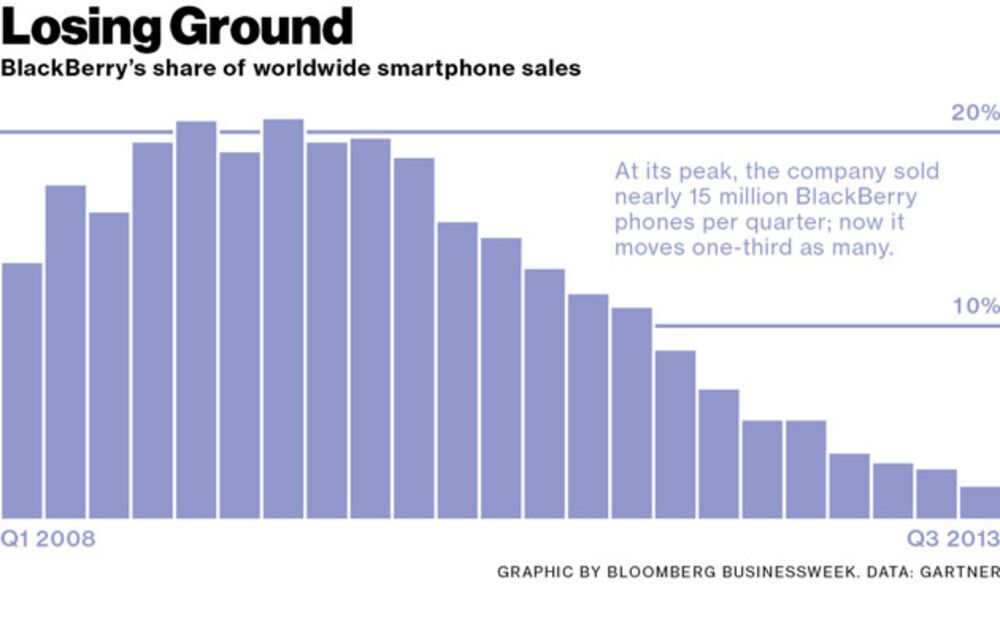
BlackBerry caused a storm in the corporate introducing it's smartphones in 1998. It went on to dominate the corporate smartphone market as the gold standard in mobile communications. The following graphic from Bloomberg really captures the subsequent rise and fall quite well:
What happened how did the iPhone, unveiled in 2007, and the Android Operating System outflank the Blackberry?
This article in the New Yorker larger blames BlackBerry's inability to understand the trend of "consumerization of IT": users wanted to use their latest iPhone or Android device instead of the BlackBerry in the corporate environment - and was it just a matter of technology to make this happen.
Although luminaries, such as Clay Christensen, have written extensively on the challenge of innovation. And there's always the problem of hindsight bias.
However, is the problem more basic?
When we look at the financial crisis, some people like to blame poor modeling. But I think that is more convenient than accepting the reality that people got swept up in the wave.
Isn’t it fair to say that people knew that house of cards was going to come down (and some of the investment banks were even betting on it falling apart), but were overly optimistic that they would get out before everyone else does?
But that’s the point.
When we are in a situation where we are surrounded by people who confirm our understanding of the world – we may believe them instead of trying to see if our understanding of the situation is correct. With the housing bubble, the key players wanted to believe that those models were correct – even though models have failed the infamous Long Term Capital Management.
With BlackBerry, what I wonder is did they not even try to see within their families and those around them who were using the iPhone or Android devices? Weren’t they curious what “all the fuss was about”?
Although this is problem with many of us who want to believe that the present situation is going to continue indefinitely (especially when things are going our way), there are others who do stay on top of things. Most notably is the Encyclopedia Britannica that actually stopped issuing physical encyclopedias and moved to the digital channel instead.
Change is a challenge, but the key is to be prepared to admit that the current way of doing things can be done better, faster and in radically different way.
Technology, security, analytics and innovation in the world of audit and business.
Showing posts with label technology. Show all posts
Wednesday, September 28, 2016
Wednesday, June 17, 2015
Can Inadequate Disaster Recovery Planning be worse than locusts?
Why are US farmers facing a disaster?
Is it due to locusts? No.
It's due to inadequate IT disaster recovery planning.
As reported in the Wall Street Journal, the US Immigration Department is unable to issue visas to temporary workers due to a system failure. Specifically:
"“The system that helps perform necessary security checks has suffered hardware failure,” said Niles Cole, a State Department spokesman. “Until it is repaired, no visas can be issued.” He said technicians are working around the clock to resolve the issue but couldn’t offer a timeline for when the system would be back in action.
Specifically, a central database isn't receiving biometric information from U.S. consulates world-wide, he said. Biometric data, including fingerprints, are used for security screening of applicants."
And the losses are mounting daily. Over 200 workers are sitting at the Mexican-US border waiting to be processed by system so they can get into the US and help harvest the crops. The article reported that farmers are losing between $500,000 to $1,000,000 per day because the fruits are spoiling.
Reading this article I had the following questions
Why isn't there a hot site?
Given the importance of the technology, why don't they have the ability to swap to a new piece of hardware instantaneously?
Was the security information backed up and why is there no manual work around?
If it's digital information, why isn't there a manual work around to transmit the information and circumvent the faulty hardware? The data could be manually uploaded to the central database.
Was a proper risk assessment done? When a disaster recovery plan (DRP) is created for a system, the organization must determine the Recovery Time Objective (RTO) that determines how quickly a system will be stored after failure. Google, for example, has an RTO of zero. To determine what the RTO is there needs to be an assessment of the impact of such a failure. In this case when setting the RTO did the risk management professional include the fact that this system was critical in supporting the visa program H2-A for temporary farm workers? It should be noted that the US farmers association had paid into this program and now they are suffering losses of over $500,000. This will also reduce the amount of tourist visas issued potentially resulting in lost tourist dollars to the US.
The lesson we can learn from this is to ensure that we understand what business processes a system supports and understand the impact to those business processes should the system go down.
Is it due to locusts? No.
It's due to inadequate IT disaster recovery planning.
As reported in the Wall Street Journal, the US Immigration Department is unable to issue visas to temporary workers due to a system failure. Specifically:
"“The system that helps perform necessary security checks has suffered hardware failure,” said Niles Cole, a State Department spokesman. “Until it is repaired, no visas can be issued.” He said technicians are working around the clock to resolve the issue but couldn’t offer a timeline for when the system would be back in action.
Specifically, a central database isn't receiving biometric information from U.S. consulates world-wide, he said. Biometric data, including fingerprints, are used for security screening of applicants."
And the losses are mounting daily. Over 200 workers are sitting at the Mexican-US border waiting to be processed by system so they can get into the US and help harvest the crops. The article reported that farmers are losing between $500,000 to $1,000,000 per day because the fruits are spoiling.
Reading this article I had the following questions
Why isn't there a hot site?
Given the importance of the technology, why don't they have the ability to swap to a new piece of hardware instantaneously?
Was the security information backed up and why is there no manual work around?
If it's digital information, why isn't there a manual work around to transmit the information and circumvent the faulty hardware? The data could be manually uploaded to the central database.
Was a proper risk assessment done? When a disaster recovery plan (DRP) is created for a system, the organization must determine the Recovery Time Objective (RTO) that determines how quickly a system will be stored after failure. Google, for example, has an RTO of zero. To determine what the RTO is there needs to be an assessment of the impact of such a failure. In this case when setting the RTO did the risk management professional include the fact that this system was critical in supporting the visa program H2-A for temporary farm workers? It should be noted that the US farmers association had paid into this program and now they are suffering losses of over $500,000. This will also reduce the amount of tourist visas issued potentially resulting in lost tourist dollars to the US.
The lesson we can learn from this is to ensure that we understand what business processes a system supports and understand the impact to those business processes should the system go down.
Labels:
backup,
disaster recovery,
DR,
farmers,
Google,
guest workers,
risk,
risk management,
RTO,
technology,
US farmers,
WSJ
Thursday, February 19, 2015
TMT Predictions: Innovation heads back to the Enterprise?
One of the key trends in the recent years, has been the consumerization of IT.
What is the consumerization of IT?
In the first few decades of computing device, the focus of technological innovation was the enterprise. For example, mainframe computers were something only businesses could and would buy. However, that changed in the past decade. The focus of innovation became the consumer. With Moore's law eating away at the price of laptops, and the mobile device revolution with Apple & Google, it became easier for consumers to afford the latest and greatest device. Carrier subsidies for these devices also fueled the availability of the device. The culmination of this trend was the Bring Your Own Device (BYOD), where companies allowed employees to bring the Macs or iDevice and attach it to the network. This made the employees happy (even though they had to support their own device) and the companies happy because they paid for less devices and saved around the administration and maintenance of these devices.
As an independent consultant, I experienced this trend first hand: I had better technology by way of laptops and mobile devices than multi-billion dollar clients.
In previous posts, (e.g. this one) we noted how this was one of the key factors in terms of eating BlackBerry's lunch: the corporate mobile device market.
Well, according Duncan Stewart & Paul Lee (and the rest of the TMT Predictions Team at Deloitte), the new trend they see coming is the re-enterprization of IT:
As they explain in the video, the specific areas that they see this as a trend are:
For more on the TMT Tech trends, see here.
What is the consumerization of IT?
In the first few decades of computing device, the focus of technological innovation was the enterprise. For example, mainframe computers were something only businesses could and would buy. However, that changed in the past decade. The focus of innovation became the consumer. With Moore's law eating away at the price of laptops, and the mobile device revolution with Apple & Google, it became easier for consumers to afford the latest and greatest device. Carrier subsidies for these devices also fueled the availability of the device. The culmination of this trend was the Bring Your Own Device (BYOD), where companies allowed employees to bring the Macs or iDevice and attach it to the network. This made the employees happy (even though they had to support their own device) and the companies happy because they paid for less devices and saved around the administration and maintenance of these devices.
As an independent consultant, I experienced this trend first hand: I had better technology by way of laptops and mobile devices than multi-billion dollar clients.
In previous posts, (e.g. this one) we noted how this was one of the key factors in terms of eating BlackBerry's lunch: the corporate mobile device market.
Well, according Duncan Stewart & Paul Lee (and the rest of the TMT Predictions Team at Deloitte), the new trend they see coming is the re-enterprization of IT:
As they explain in the video, the specific areas that they see this as a trend are:
- Wearables
- 3D Printing
- Internet of Things
- Drones
Finally, as they note at the end, the shift of focus back to the enterprise is advantageous from a fit perspective - devices from the ground up will be created to meet the needs of the enterprise. From IS and audit perspective, the move will likely enhance the information security and information integrity as these technologies will be easier to integrate into the security architecture and the actual processing environment.
For more on the TMT Tech trends, see here.
Friday, December 5, 2014
Remembering those Blackberry days
The Globe and Mail reported on BlackBerry's latest approach in terms of rebuilding its mobile user base. The company is offering $400 trade + a $150 gift card for anyone who trades in their iPhone for the rather odd square shaped Passport. Here is the review from the Verge regarding the latest:
Coincidentally, I came across an BlackBerry of mine: the Torch. I remembered thinking that after using the device how it was the perfect compromise between the touch screen and the classic keyboard. However, that feeling faded quite quickly: the device was so under-powered compared to the competition and of course it lacked the apps that you could find in the Apple AppStore. But at the time I could never imagine giving up the physical QWERTY keyboard.
Since then I have moved onto Android and more specifically to the SwiftKey keyboard - to the point I can't go back to a physical keyboard!
How did BlackBerry fail to keep up with the times?
As noted in this article, Mike Lazaridis the founder of the CEO, was inspired to develop the BlackBerry when he recalled his teacher's advice while watching a presentation in 1987 - almost a decade before the Internet - on how Coke used wireless technology to manage the inventory at the vending machines. What was his teacher's advice? His teacher advised him not to get swept in the computer craze as the real boon lay in integrating wireless technology with computers.
BlackBerry caused a storm in the corporate introducing it's smartphones in 1998. It went on to dominate the corporate smartphone market as the gold standard in mobile communications. The following graphic from Bloomberg really captures the subsequent rise and fall quite well:
What happened how did the iPhone, unveiled in 2007, and the Android Operating System outflank the Blackberry? This article in the New Yorker larger blames BlackBerry's inability to understand the trend of "consumerization of IT": users wanted to use their latest iPhone or Android device instead of the BlackBerry in the corporate environment - and was it just a matter of technology to make this happen.
Although luminaries, such as Clay Christensen, have written extensively on the challenge of innovation. And there's always the problem of hindsight bias. However, is the problem more basic? When we look at the financial crisis, some people like to blame poor modeling. But I think that is more convenient than accepting the reality that people got swept up in the wave.
Isn’t it fair to say that people knew that house of cards was going to come down (and some of the investment banks were even betting on it falling apart), but were overly optimistic that they would get out before everyone else does?
But that’s the point.
When we are in a situation where we are surrounded by people who confirm our understanding of the world – we may believe them instead of trying to see if our understanding of the situation is correct. With the housing bubble, the key players wanted to believe that those models were correct – even though models have failed the infamous Long Term Capital Management. With BlackBerry what was it? Did they think their hold over the corporate IT? What I wonder is did they not even try to see within their families and those around them who were using the iPhone or Android devices? Weren’t they curious what “all the fuss was about”?
Although this is problem with many of us who want to believe that the present situation is going to continue indefinitely (especially when things are going our way), there are others who do stay on top of things. Most notably is the Encyclopedia Britannica that actually stopped issuing physical encyclopedias and moved to the digital channel instead.
Change is a challenge, but the key is to be prepared to admit that the current way of doing things can be done better, faster and in radically different way.
Coincidentally, I came across an BlackBerry of mine: the Torch. I remembered thinking that after using the device how it was the perfect compromise between the touch screen and the classic keyboard. However, that feeling faded quite quickly: the device was so under-powered compared to the competition and of course it lacked the apps that you could find in the Apple AppStore. But at the time I could never imagine giving up the physical QWERTY keyboard.
Since then I have moved onto Android and more specifically to the SwiftKey keyboard - to the point I can't go back to a physical keyboard!
How did BlackBerry fail to keep up with the times?
As noted in this article, Mike Lazaridis the founder of the CEO, was inspired to develop the BlackBerry when he recalled his teacher's advice while watching a presentation in 1987 - almost a decade before the Internet - on how Coke used wireless technology to manage the inventory at the vending machines. What was his teacher's advice? His teacher advised him not to get swept in the computer craze as the real boon lay in integrating wireless technology with computers.
BlackBerry caused a storm in the corporate introducing it's smartphones in 1998. It went on to dominate the corporate smartphone market as the gold standard in mobile communications. The following graphic from Bloomberg really captures the subsequent rise and fall quite well:

Although luminaries, such as Clay Christensen, have written extensively on the challenge of innovation. And there's always the problem of hindsight bias. However, is the problem more basic? When we look at the financial crisis, some people like to blame poor modeling. But I think that is more convenient than accepting the reality that people got swept up in the wave.
Isn’t it fair to say that people knew that house of cards was going to come down (and some of the investment banks were even betting on it falling apart), but were overly optimistic that they would get out before everyone else does?
But that’s the point.
When we are in a situation where we are surrounded by people who confirm our understanding of the world – we may believe them instead of trying to see if our understanding of the situation is correct. With the housing bubble, the key players wanted to believe that those models were correct – even though models have failed the infamous Long Term Capital Management. With BlackBerry what was it? Did they think their hold over the corporate IT? What I wonder is did they not even try to see within their families and those around them who were using the iPhone or Android devices? Weren’t they curious what “all the fuss was about”?
Although this is problem with many of us who want to believe that the present situation is going to continue indefinitely (especially when things are going our way), there are others who do stay on top of things. Most notably is the Encyclopedia Britannica that actually stopped issuing physical encyclopedias and moved to the digital channel instead.
Change is a challenge, but the key is to be prepared to admit that the current way of doing things can be done better, faster and in radically different way.
Labels:
blackberry,
encyclopedia,
financial crisis,
hindsight bias,
innovation,
RIM,
technology
Tuesday, February 26, 2013
Technology and Audit: Rising tide of tech floats all boats
Norman Marks, evangelist at SAP, neatly summarizes in this 5 minute video the implications of the how the recent technologies, such as cloud, analytics, and the like has implications on the auditing profession.
As he notes, "if it's good enough for our clients, it's good enough for us" (i.e. us being the auditing profession). He mentions how individual analysts and other business professionals are using tablets and other devices to perform analytics. He also cautions that we should not make the same mistake as we did when analyzing the potential for desktop computing. In the video he narrates an amusing anecdote about the reaction of the accounting firm that he worked at to the nascent, desktop computer in the 70s.
Although I agree with his comments, I would say that this also extends beyond the corporate IT environment I have written in the past about cloud and mobile tech and what I see is that these technologies favour the small and medium sized business (SMBs) over the large ones. Basically, SMBs can now afford enterprise class technology and are probably using this technology within their personal spheres. Hence the term "consumerization of IT": advances in technology are focused in the consumer space not the corporate IT Department. As illustrated by the use of the iPhone within the corporate IT, consumers brought or demanded that IT let them use the iPhone instead of the standard issue (e.g. BlackBerry) smartphone. Furthermore, widespread familiarity with these technologies allows SMBs access to employees who know how to use these technologies - without specialized training. The sum of it: it is much harder for auditors to justify being low-tech, when even the employee of the SMB has gone high tech.
As he notes, "if it's good enough for our clients, it's good enough for us" (i.e. us being the auditing profession). He mentions how individual analysts and other business professionals are using tablets and other devices to perform analytics. He also cautions that we should not make the same mistake as we did when analyzing the potential for desktop computing. In the video he narrates an amusing anecdote about the reaction of the accounting firm that he worked at to the nascent, desktop computer in the 70s.
Although I agree with his comments, I would say that this also extends beyond the corporate IT environment I have written in the past about cloud and mobile tech and what I see is that these technologies favour the small and medium sized business (SMBs) over the large ones. Basically, SMBs can now afford enterprise class technology and are probably using this technology within their personal spheres. Hence the term "consumerization of IT": advances in technology are focused in the consumer space not the corporate IT Department. As illustrated by the use of the iPhone within the corporate IT, consumers brought or demanded that IT let them use the iPhone instead of the standard issue (e.g. BlackBerry) smartphone. Furthermore, widespread familiarity with these technologies allows SMBs access to employees who know how to use these technologies - without specialized training. The sum of it: it is much harder for auditors to justify being low-tech, when even the employee of the SMB has gone high tech.
Labels:
audit,
CAATs,
Cloud,
consumerization,
Internal audit,
Norman Marks,
tablets,
technology
Wednesday, June 6, 2012
Oracle & Google IP Trial: the Judge is the Gem
Last week the "WorldSeries of intellectual property trials" came to a close. Oracle, who purchased Sun Microsystems, was suing Google over its use over Java. Oracle claimed the Google had infringed on 37 of its copyright "APIs" or application programming interfaces.
What is an API, you may ask? I also had the same question and found the following resources that may be of help:
- Simplest definition that I found was on the Guardian's reporting of the trial who defined APIs as "computer language that connects programs and operating systems – known as application programming interfaces". But I wasn't satisfied with that, so I dug some more.
- CNET had a number of good resources on the topic. This FAQ gives a good broad overview of Java and explains the relevance of APIs to the programming language. However, the article that probably sheds the most light on the topic is this one. The article walks through a key part of the trial where Joshua Bloch (former Sun Java-expert-engineer now working for Google) defines an API "as "names or words and a set of rules." When the program speaks to a library, it has speak in a very precise language, he continued. Typically the words are verbs and phrases, such as "remove the header."". What is also helpful is the accompanying slideshow that illustrates the lines of codes that Oracle claimed that Google infringed upon.
Google sought to pay Oracle 2.8 million, but Oracle wanted a cool billion for what it deemed to be a violation of the copyrights. The end result was that Oracle lost; the judge delivered a narrow ruling that Google use of the APIs was not a violation of copyright because APIs cannot be copyrighted. As reported on GigaOm, "The crux of Alsup’s ruling today is that 37 of the Java application programming interfaces aren’t eligible for copyright in the first place. Copyright typically protects authors’ work — in the form of books, music, computer code, etc — but doesn’t extend to functions or ideas."
IP: A drain on innovation
The case is a good piece of evidence for those that are critical over the patenting of software.Critics, such as John C. Dovorak, point out that the system is dysfunctional altogether. From a resource allocation point of view, this trial illustrates that a significant amount of resources are dedicated to litigation. According to Patrick Doody, an-ex partner at Pillsbury law firm, the trial is estimated to cost $50 million. Leo Laporte, owner of the This-week-in-Tech (TWIT network), routinely points out in the podcasts that he produces - that software giants waste money on patent suits instead of spending those same funds on innovation. To quantify his argument: if the average salary paid to an IT professional is $80,000,Google and Oracle could have invested in about 625 full-time equivalents (FTEs) worth of work instead of litigating this trial. Of course such logic is lost on Capitalist enterprise, whose focus is profits over innovation.
Technology & Society: A Watershed Moment
Another nugget that came out of this trial was the reason that judge William Alsup's (the judge presiding over the trial) rejected Oracle's argument. The judge challenged Oracle's assumption that a "range check" was difficult to build - because he knew how to code in Java!
According to Wired, "he had learned to code in Java for the trial — implying that he knew other languages as well — and he said that he had written some of the infringing code at least a hundred times since Oracle filed its suit in August 2010. “I can do it. You can do it. It’s so simple,” he said, adding that it takes less than five minutes. Then looked directly at Boies. “You’re one of the best lawyers in America — how can you make that argument?” he demanded."
Posts in the tech community, notably on I-Programmer and O'Reilly, point out that this is a watershed moment in society: code and technology is "a part of the world we live in".
Can one make the analogy that if judges should be this technology proficient, so should audit practitioners?
Given the nature of the accounting profession, it would be difficult to make it mandatory for audit practitioners to program. However, on the other hand, the profession should use this opportunity to re-examine what aspects of technology should be a part of the audit practitioners skill set - given that is clear that society's attitude towards technology has clearly changed.
Labels:
accountants,
API,
auditors,
CA,
competency,
Google,
Oracle,
society,
technology
Subscribe to:
Posts (Atom)