Recently, Globe and Mail noted in their political briefing newsletter that Samsung's Knox software is deemed to be as secure as the traditional BlackBerry:
"Shared Services Canada, the department in charge of overseeing IT for the federal government, is set to offer alternatives to bureaucrats over the next 18 months as part of “a new approach to mobile service to better serve its clients, use new technology and adapt to changes in the marketplace.” Samsung and its line of Android-powered smartphones was the first to be approved by Shared Services, but only after two years and several tests showed that Samsung’s phones passed military-grade requirements."
In this blog, we've covered Blackberry's steady fall into oblivion. For me, BlackBerry was my first smartphone. I even got excited about the Torch, thinking it was the perfect compromise between the touch screen and the classic keyboard. However, that feeling faded quite quickly after using the device. It was so underpowered and underwhelming compared to the competition.
When looking at the Porter 5 forces that surrounded this once mighty Canadian tech giant, we could say that both Apple's iOS and Android offer better substitute's: better devices, more power, better apps, etc. Essentially, these devices has evolved so much that they bring the power of the PC into the palm of one's head (Samsung's Note 8 is expected to have 6GB of RAM!). This alone doesn't explain why BlackBerry was ultimately displaced from corporate IT - well before Samsung's Knox became equal-to-BlackBerry in terms of security.
I think there were two key developments that enabled BlackBerry's decline.
The more well known one is the "consumerization of IT" phenomenon: users wanted to use their latest iPhone or Android device instead of the BlackBerry in the corporate environment. Going back to Porter 5 forces this speaks to "bargaining power of buyers": the people no longer wanted to be limited to the "one trick pony" of email and BB Messenger. And they were willing to lobby their corporate IT departments to bring on the Android and Apple devices.
This leads to the second less well known factor.
What allowed consumerization to take place was that Microsoft took an open approach to licensing it Exchange Active Sync. This move paved the way for iPhone and Android to connect their devices to the corporate email server. Microsoft open attitude essentially transferred the power from BlackBerry to the consumer.
But for me it was a little different. Of course I like the apps and GPS that my Android and iPhone bring to me: the ability to read the Kindle, listen to audio books and podcasts without having to carry multiple devices is definitely a productivity. But really it was one particular app that made me able to switch: SwiftKey.
And that's where we get to the artificial intelligence.
I was a big fan of the Blackberry, primarily because I thought I couldn't live without the physical QWERTY keyboard. But friends who were encouraging me to switch mentioned that Android sported the SwiftKey keyboard which is powered by artificial intelligence. This keyboard is much better for me in terms of learning the words I use when I type than the predictive text feature in its iOS counterpart (which I use for work).
A little while ago, I tried a colleague's BlackBerry and the irony is that my hands hurt. And that's probably because I type a lot less specifically because of the AI approach taken by SwiftKey. As per the native analytics tracker (see graphic below) in my app I have been saved myself over 350,000 taps and am 28% more efficient.
Today, over a quarter billion people use SwiftKey on their mobile devices. Although a little hidden from the view of analysts and academics, advances in artificial intelligence enabled SwiftKey (now owned by Microsoft) to offer a substitute for the once dominant BlackBerry physical keyboard. And for me personally it was this little piece of exponential technology (along with the relatively giant landscape of the Samsung Note 1) that convinced me it was time to switch.
And like I said, I can never go back.
Author: Malik Datardina, CPA, CA, CISA. Malik works at Auvenir as a GRC Strategist that is working to transform the engagement experience for accounting firms and their clients. The opinions expressed here do not necessarily represent UWCISA, UW, Auvenir (or its affiliates), CPA Canada or anyone else
Technology, security, analytics and innovation in the world of audit and business.
Showing posts with label blackberry. Show all posts
Tuesday, August 22, 2017
Did artificial intelligence kill the BlackBerry? It did for me.
Labels:
AI,
Artificial Intelligence,
blackberry,
canada,
exponential technology,
Knox,
Microsoft,
mobile,
neural networks,
Porter 5 forces,
RIM,
Samsung,
SwiftKey
Wednesday, September 28, 2016
End of an Era: Blackberry to exit hardware business
CBC reported that Blackberry is exiting the hardware business. The news doesn't come as a surprise. As noted in this interview with CNBC in June of this year, the interviewer notes how Blackberry was steadily outsourcing the manufacturing of its devices. The CEO, John Chen, also confirmed that they were planning on exiting the business if it failed to be profitable:
Blackberry was my first smartphone, the 8900, to be exact.
However, when I saw the Torch, I remember thinking that after using the device how it was the perfect compromise between the touch screen and the classic keyboard. However, that feeling faded quite quickly after using the device. It was so under-powered compared to the competition and of course it lacked the apps that you could find in the Apple AppStore. But at the time I could never imagine giving up the physical QWERTY keyboard.
Since then I have moved onto Android and more specifically to the SwiftKey keyboard - to the point I can't go back to a physical keyboard!
How did BlackBerry fail to keep up with the times?
As noted in this article, Mike Lazaridis the founder of the CEO, was inspired to develop the BlackBerry when he recalled his teacher's advice while watching a presentation in 1987 - almost a decade before the Internet - on how Coke used wireless technology to manage the inventory at the vending machines. What was his teacher's advice? His teacher advised him not to get swept in the computer craze as the real boon lay in integrating wireless technology with computers.
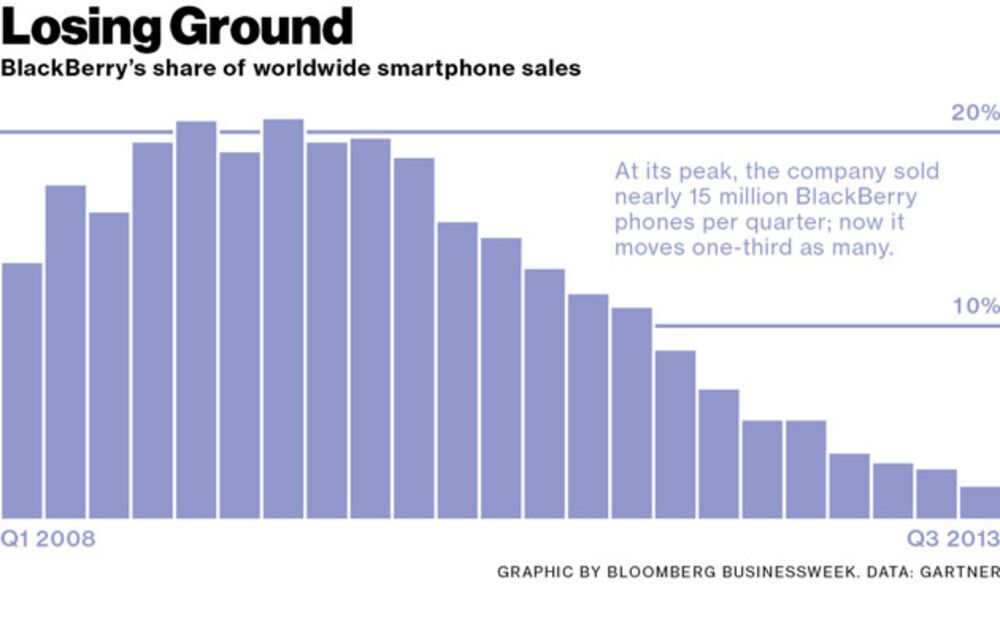
BlackBerry caused a storm in the corporate introducing it's smartphones in 1998. It went on to dominate the corporate smartphone market as the gold standard in mobile communications. The following graphic from Bloomberg really captures the subsequent rise and fall quite well:
What happened how did the iPhone, unveiled in 2007, and the Android Operating System outflank the Blackberry?
This article in the New Yorker larger blames BlackBerry's inability to understand the trend of "consumerization of IT": users wanted to use their latest iPhone or Android device instead of the BlackBerry in the corporate environment - and was it just a matter of technology to make this happen.
Although luminaries, such as Clay Christensen, have written extensively on the challenge of innovation. And there's always the problem of hindsight bias.
However, is the problem more basic?
When we look at the financial crisis, some people like to blame poor modeling. But I think that is more convenient than accepting the reality that people got swept up in the wave.
Isn’t it fair to say that people knew that house of cards was going to come down (and some of the investment banks were even betting on it falling apart), but were overly optimistic that they would get out before everyone else does?
But that’s the point.
When we are in a situation where we are surrounded by people who confirm our understanding of the world – we may believe them instead of trying to see if our understanding of the situation is correct. With the housing bubble, the key players wanted to believe that those models were correct – even though models have failed the infamous Long Term Capital Management.
With BlackBerry, what I wonder is did they not even try to see within their families and those around them who were using the iPhone or Android devices? Weren’t they curious what “all the fuss was about”?
Although this is problem with many of us who want to believe that the present situation is going to continue indefinitely (especially when things are going our way), there are others who do stay on top of things. Most notably is the Encyclopedia Britannica that actually stopped issuing physical encyclopedias and moved to the digital channel instead.
Change is a challenge, but the key is to be prepared to admit that the current way of doing things can be done better, faster and in radically different way.
Blackberry was my first smartphone, the 8900, to be exact.
However, when I saw the Torch, I remember thinking that after using the device how it was the perfect compromise between the touch screen and the classic keyboard. However, that feeling faded quite quickly after using the device. It was so under-powered compared to the competition and of course it lacked the apps that you could find in the Apple AppStore. But at the time I could never imagine giving up the physical QWERTY keyboard.
Since then I have moved onto Android and more specifically to the SwiftKey keyboard - to the point I can't go back to a physical keyboard!
How did BlackBerry fail to keep up with the times?
As noted in this article, Mike Lazaridis the founder of the CEO, was inspired to develop the BlackBerry when he recalled his teacher's advice while watching a presentation in 1987 - almost a decade before the Internet - on how Coke used wireless technology to manage the inventory at the vending machines. What was his teacher's advice? His teacher advised him not to get swept in the computer craze as the real boon lay in integrating wireless technology with computers.
BlackBerry caused a storm in the corporate introducing it's smartphones in 1998. It went on to dominate the corporate smartphone market as the gold standard in mobile communications. The following graphic from Bloomberg really captures the subsequent rise and fall quite well:
What happened how did the iPhone, unveiled in 2007, and the Android Operating System outflank the Blackberry?
This article in the New Yorker larger blames BlackBerry's inability to understand the trend of "consumerization of IT": users wanted to use their latest iPhone or Android device instead of the BlackBerry in the corporate environment - and was it just a matter of technology to make this happen.
Although luminaries, such as Clay Christensen, have written extensively on the challenge of innovation. And there's always the problem of hindsight bias.
However, is the problem more basic?
When we look at the financial crisis, some people like to blame poor modeling. But I think that is more convenient than accepting the reality that people got swept up in the wave.
Isn’t it fair to say that people knew that house of cards was going to come down (and some of the investment banks were even betting on it falling apart), but were overly optimistic that they would get out before everyone else does?
But that’s the point.
When we are in a situation where we are surrounded by people who confirm our understanding of the world – we may believe them instead of trying to see if our understanding of the situation is correct. With the housing bubble, the key players wanted to believe that those models were correct – even though models have failed the infamous Long Term Capital Management.
With BlackBerry, what I wonder is did they not even try to see within their families and those around them who were using the iPhone or Android devices? Weren’t they curious what “all the fuss was about”?
Although this is problem with many of us who want to believe that the present situation is going to continue indefinitely (especially when things are going our way), there are others who do stay on top of things. Most notably is the Encyclopedia Britannica that actually stopped issuing physical encyclopedias and moved to the digital channel instead.
Change is a challenge, but the key is to be prepared to admit that the current way of doing things can be done better, faster and in radically different way.
Tuesday, July 7, 2015
Can BlackBerry get back in the game with using the Android OS?
Late last year I wrote in a post reminiscing about those good old BlackBerry Days: days when Canada's very own tech darling, Research-in-Motion (as it was called back then), was the hot technology that executives and business savvy individuals had in their pockets.
In the post, I discussed the possible factors that led to the decline, wondering how the RIM exec's did not just go out and try one of the Android or iPhone devices to see why these brands were overtaking theirs.
Well, not sure if they read my post - in fact I highly doubt it :) - BlackBerry appears to be toying with the idea of using the Android OS instead of its BB10. As noted in the following edition of Android Authority, rumours are a swirling about the Android OS being loaded onto BlackBerry phones (starts around 1:10).
If this ends up being true, then this could be (for real this time!) that could get BlackBerry into the game. However, this hinges on BB being able to leverage their corporate customers to get this device to integrate with the corporate IT (especially email and calendar). For example, my employer support iPhones and BB but not Android.
So I have been contemplating on whether I should get a iPhone on my next upgrade.
However, if BlackBerry were to switch to Android then I would definitely consider that as an option. For me the issue is when I am travelling on business, I need to use my phone. However, the native BB apps are simply not the greatest and I miss using the Google Maps and other services.
There's definitely a good strategic analysis of how BB can benefit from the Android App store or offer users cutting edge services. However, it probably just simply boils down to a strategy of if you can't beat them you might as well join them!
So I have been contemplating on whether I should get a iPhone on my next upgrade.
However, if BlackBerry were to switch to Android then I would definitely consider that as an option. For me the issue is when I am travelling on business, I need to use my phone. However, the native BB apps are simply not the greatest and I miss using the Google Maps and other services.
There's definitely a good strategic analysis of how BB can benefit from the Android App store or offer users cutting edge services. However, it probably just simply boils down to a strategy of if you can't beat them you might as well join them!
Thursday, February 26, 2015
Google: Business Geniuses?
Just yesterday, I was talking to a colleague about Google's business strategy. As I mentioned on a previous post, Google's move into the phone and ISP markets illustrates it understands the importance of not being reliant on third parties to provide the "last mile" to the consumer. Instead, they need to make in-roads into the space to prevent being elbowed out by other players who want to use their muscle to exert anti-competitive behaviour on Google.
And Google should be afraid of such tendencies.
Contrary to Capitalist mythology, innovation does not trump all. In fact, if it is easier (i.e. more profitable) for the king of the mountain, so to say, to kick upstarts and start-ups off of the mountain, then they will do that rather than innovate. Take for example David Sarnoff of RCA. He worked to crush the FM radio technology - even though it was superior - to his AM radio technology because it would disrupt his business.
Coincidentally, the Globe and Mail reported that Google is making a push into the business arena:
"The tools include the ability to create separate personal and professional profiles on the same phone in an effort to reassure workers worried about their bosses snooping on their private lives. Even though the data is kept in separate silos, Google has created a way for work programs and personal apps such as Facebook to appear on the same home screen for convenience"
It seems that Google has adopted BlackBerry's "Balance" feature that enables it to separate personal and work related apps and data.
Google has a website dedicated to this initiative (for the announcement see here). The website also has an impressive list of partners who are working with Google on this. As evidenced by this video, this project had been officially unveiled last summer:
Given Google's eminence in Big Data and Cloud Computing, I am waiting to see how these features will be incorporated into future offerings that were focused on the enterprise.
And Google should be afraid of such tendencies.
Contrary to Capitalist mythology, innovation does not trump all. In fact, if it is easier (i.e. more profitable) for the king of the mountain, so to say, to kick upstarts and start-ups off of the mountain, then they will do that rather than innovate. Take for example David Sarnoff of RCA. He worked to crush the FM radio technology - even though it was superior - to his AM radio technology because it would disrupt his business.
Coincidentally, the Globe and Mail reported that Google is making a push into the business arena:
"The tools include the ability to create separate personal and professional profiles on the same phone in an effort to reassure workers worried about their bosses snooping on their private lives. Even though the data is kept in separate silos, Google has created a way for work programs and personal apps such as Facebook to appear on the same home screen for convenience"
It seems that Google has adopted BlackBerry's "Balance" feature that enables it to separate personal and work related apps and data.
Google has a website dedicated to this initiative (for the announcement see here). The website also has an impressive list of partners who are working with Google on this. As evidenced by this video, this project had been officially unveiled last summer:
Given Google's eminence in Big Data and Cloud Computing, I am waiting to see how these features will be incorporated into future offerings that were focused on the enterprise.
Labels:
Android,
Android Work,
balance,
blackberry,
Google,
mobile
Friday, December 5, 2014
Remembering those Blackberry days
The Globe and Mail reported on BlackBerry's latest approach in terms of rebuilding its mobile user base. The company is offering $400 trade + a $150 gift card for anyone who trades in their iPhone for the rather odd square shaped Passport. Here is the review from the Verge regarding the latest:
Coincidentally, I came across an BlackBerry of mine: the Torch. I remembered thinking that after using the device how it was the perfect compromise between the touch screen and the classic keyboard. However, that feeling faded quite quickly: the device was so under-powered compared to the competition and of course it lacked the apps that you could find in the Apple AppStore. But at the time I could never imagine giving up the physical QWERTY keyboard.
Since then I have moved onto Android and more specifically to the SwiftKey keyboard - to the point I can't go back to a physical keyboard!
How did BlackBerry fail to keep up with the times?
As noted in this article, Mike Lazaridis the founder of the CEO, was inspired to develop the BlackBerry when he recalled his teacher's advice while watching a presentation in 1987 - almost a decade before the Internet - on how Coke used wireless technology to manage the inventory at the vending machines. What was his teacher's advice? His teacher advised him not to get swept in the computer craze as the real boon lay in integrating wireless technology with computers.
BlackBerry caused a storm in the corporate introducing it's smartphones in 1998. It went on to dominate the corporate smartphone market as the gold standard in mobile communications. The following graphic from Bloomberg really captures the subsequent rise and fall quite well:
What happened how did the iPhone, unveiled in 2007, and the Android Operating System outflank the Blackberry? This article in the New Yorker larger blames BlackBerry's inability to understand the trend of "consumerization of IT": users wanted to use their latest iPhone or Android device instead of the BlackBerry in the corporate environment - and was it just a matter of technology to make this happen.
Although luminaries, such as Clay Christensen, have written extensively on the challenge of innovation. And there's always the problem of hindsight bias. However, is the problem more basic? When we look at the financial crisis, some people like to blame poor modeling. But I think that is more convenient than accepting the reality that people got swept up in the wave.
Isn’t it fair to say that people knew that house of cards was going to come down (and some of the investment banks were even betting on it falling apart), but were overly optimistic that they would get out before everyone else does?
But that’s the point.
When we are in a situation where we are surrounded by people who confirm our understanding of the world – we may believe them instead of trying to see if our understanding of the situation is correct. With the housing bubble, the key players wanted to believe that those models were correct – even though models have failed the infamous Long Term Capital Management. With BlackBerry what was it? Did they think their hold over the corporate IT? What I wonder is did they not even try to see within their families and those around them who were using the iPhone or Android devices? Weren’t they curious what “all the fuss was about”?
Although this is problem with many of us who want to believe that the present situation is going to continue indefinitely (especially when things are going our way), there are others who do stay on top of things. Most notably is the Encyclopedia Britannica that actually stopped issuing physical encyclopedias and moved to the digital channel instead.
Change is a challenge, but the key is to be prepared to admit that the current way of doing things can be done better, faster and in radically different way.
Coincidentally, I came across an BlackBerry of mine: the Torch. I remembered thinking that after using the device how it was the perfect compromise between the touch screen and the classic keyboard. However, that feeling faded quite quickly: the device was so under-powered compared to the competition and of course it lacked the apps that you could find in the Apple AppStore. But at the time I could never imagine giving up the physical QWERTY keyboard.
Since then I have moved onto Android and more specifically to the SwiftKey keyboard - to the point I can't go back to a physical keyboard!
How did BlackBerry fail to keep up with the times?
As noted in this article, Mike Lazaridis the founder of the CEO, was inspired to develop the BlackBerry when he recalled his teacher's advice while watching a presentation in 1987 - almost a decade before the Internet - on how Coke used wireless technology to manage the inventory at the vending machines. What was his teacher's advice? His teacher advised him not to get swept in the computer craze as the real boon lay in integrating wireless technology with computers.
BlackBerry caused a storm in the corporate introducing it's smartphones in 1998. It went on to dominate the corporate smartphone market as the gold standard in mobile communications. The following graphic from Bloomberg really captures the subsequent rise and fall quite well:

Although luminaries, such as Clay Christensen, have written extensively on the challenge of innovation. And there's always the problem of hindsight bias. However, is the problem more basic? When we look at the financial crisis, some people like to blame poor modeling. But I think that is more convenient than accepting the reality that people got swept up in the wave.
Isn’t it fair to say that people knew that house of cards was going to come down (and some of the investment banks were even betting on it falling apart), but were overly optimistic that they would get out before everyone else does?
But that’s the point.
When we are in a situation where we are surrounded by people who confirm our understanding of the world – we may believe them instead of trying to see if our understanding of the situation is correct. With the housing bubble, the key players wanted to believe that those models were correct – even though models have failed the infamous Long Term Capital Management. With BlackBerry what was it? Did they think their hold over the corporate IT? What I wonder is did they not even try to see within their families and those around them who were using the iPhone or Android devices? Weren’t they curious what “all the fuss was about”?
Although this is problem with many of us who want to believe that the present situation is going to continue indefinitely (especially when things are going our way), there are others who do stay on top of things. Most notably is the Encyclopedia Britannica that actually stopped issuing physical encyclopedias and moved to the digital channel instead.
Change is a challenge, but the key is to be prepared to admit that the current way of doing things can be done better, faster and in radically different way.
Labels:
blackberry,
encyclopedia,
financial crisis,
hindsight bias,
innovation,
RIM,
technology
Subscribe to:
Posts (Atom)