CBC reported that Blackberry is exiting the hardware business. The news doesn't come as a surprise. As noted in this interview with CNBC in June of this year, the interviewer notes how Blackberry was steadily outsourcing the manufacturing of its devices. The CEO, John Chen, also confirmed that they were planning on exiting the business if it failed to be profitable:
Blackberry was my first smartphone, the 8900, to be exact.
However, when I saw the Torch, I remember thinking that after using the device how it was the perfect compromise between the touch screen and the classic keyboard. However, that feeling faded quite quickly after using the device. It was so under-powered compared to the competition and of course it lacked the apps that you could find in the Apple AppStore. But at the time I could never imagine giving up the physical QWERTY keyboard.
Since then I have moved onto Android and more specifically to the SwiftKey keyboard - to the point I can't go back to a physical keyboard!
How did BlackBerry fail to keep up with the times?
As noted in this article, Mike Lazaridis the founder of the CEO, was inspired to develop the BlackBerry when he recalled his teacher's advice while watching a presentation in 1987 - almost a decade before the Internet - on how Coke used wireless technology to manage the inventory at the vending machines. What was his teacher's advice? His teacher advised him not to get swept in the computer craze as the real boon lay in integrating wireless technology with computers.
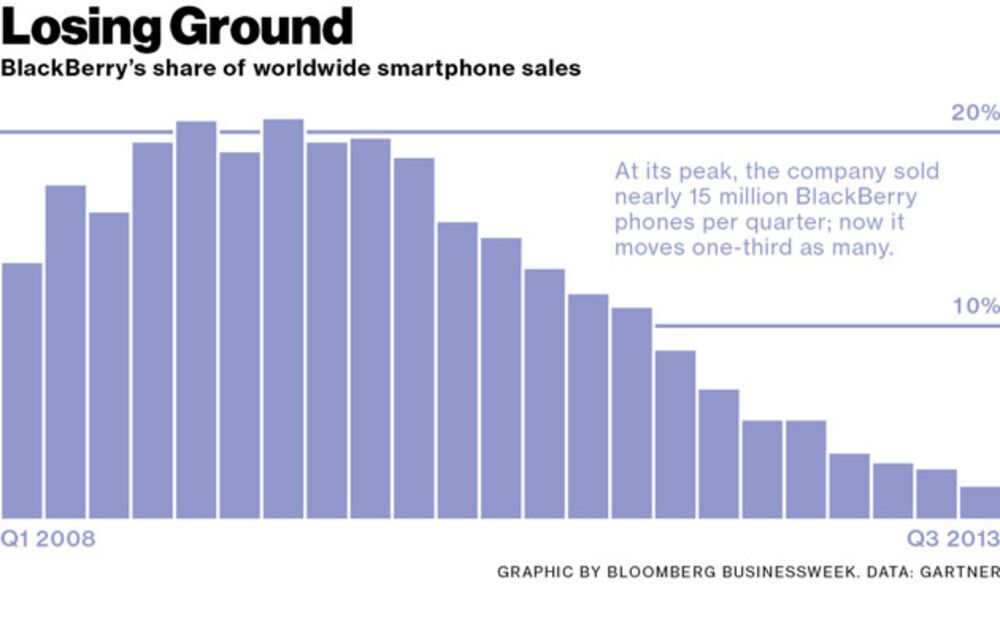
BlackBerry caused a storm in the corporate introducing it's smartphones in 1998. It went on to dominate the corporate smartphone market as the gold standard in mobile communications. The following graphic from Bloomberg really captures the subsequent rise and fall quite well:
What happened how did the iPhone, unveiled in 2007, and the Android Operating System outflank the Blackberry?
This article in the New Yorker larger blames BlackBerry's inability to understand the trend of "consumerization of IT": users wanted to use their latest iPhone or Android device instead of the BlackBerry in the corporate environment - and was it just a matter of technology to make this happen.
Although luminaries, such as Clay Christensen, have written extensively on the challenge of innovation. And there's always the problem of hindsight bias.
However, is the problem more basic?
When we look at the financial crisis, some people like to blame poor modeling. But I think that is more convenient than accepting the reality that people got swept up in the wave.
Isn’t it fair to say that people knew that house of cards was going to come down (and some of the investment banks were even betting on it falling apart), but were overly optimistic that they would get out before everyone else does?
But that’s the point.
When we are in a situation where we are surrounded by people who confirm our understanding of the world – we may believe them instead of trying to see if our understanding of the situation is correct. With the housing bubble, the key players wanted to believe that those models were correct – even though models have failed the infamous Long Term Capital Management.
With BlackBerry, what I wonder is did they not even try to see within their families and those around them who were using the iPhone or Android devices? Weren’t they curious what “all the fuss was about”?
Although this is problem with many of us who want to believe that the present situation is going to continue indefinitely (especially when things are going our way), there are others who do stay on top of things. Most notably is the Encyclopedia Britannica that actually stopped issuing physical encyclopedias and moved to the digital channel instead.
Change is a challenge, but the key is to be prepared to admit that the current way of doing things can be done better, faster and in radically different way.
Technology, security, analytics and innovation in the world of audit and business.
Showing posts with label encyclopedia. Show all posts
Wednesday, September 28, 2016
Friday, December 5, 2014
Remembering those Blackberry days
The Globe and Mail reported on BlackBerry's latest approach in terms of rebuilding its mobile user base. The company is offering $400 trade + a $150 gift card for anyone who trades in their iPhone for the rather odd square shaped Passport. Here is the review from the Verge regarding the latest:
Coincidentally, I came across an BlackBerry of mine: the Torch. I remembered thinking that after using the device how it was the perfect compromise between the touch screen and the classic keyboard. However, that feeling faded quite quickly: the device was so under-powered compared to the competition and of course it lacked the apps that you could find in the Apple AppStore. But at the time I could never imagine giving up the physical QWERTY keyboard.
Since then I have moved onto Android and more specifically to the SwiftKey keyboard - to the point I can't go back to a physical keyboard!
How did BlackBerry fail to keep up with the times?
As noted in this article, Mike Lazaridis the founder of the CEO, was inspired to develop the BlackBerry when he recalled his teacher's advice while watching a presentation in 1987 - almost a decade before the Internet - on how Coke used wireless technology to manage the inventory at the vending machines. What was his teacher's advice? His teacher advised him not to get swept in the computer craze as the real boon lay in integrating wireless technology with computers.
BlackBerry caused a storm in the corporate introducing it's smartphones in 1998. It went on to dominate the corporate smartphone market as the gold standard in mobile communications. The following graphic from Bloomberg really captures the subsequent rise and fall quite well:
What happened how did the iPhone, unveiled in 2007, and the Android Operating System outflank the Blackberry? This article in the New Yorker larger blames BlackBerry's inability to understand the trend of "consumerization of IT": users wanted to use their latest iPhone or Android device instead of the BlackBerry in the corporate environment - and was it just a matter of technology to make this happen.
Although luminaries, such as Clay Christensen, have written extensively on the challenge of innovation. And there's always the problem of hindsight bias. However, is the problem more basic? When we look at the financial crisis, some people like to blame poor modeling. But I think that is more convenient than accepting the reality that people got swept up in the wave.
Isn’t it fair to say that people knew that house of cards was going to come down (and some of the investment banks were even betting on it falling apart), but were overly optimistic that they would get out before everyone else does?
But that’s the point.
When we are in a situation where we are surrounded by people who confirm our understanding of the world – we may believe them instead of trying to see if our understanding of the situation is correct. With the housing bubble, the key players wanted to believe that those models were correct – even though models have failed the infamous Long Term Capital Management. With BlackBerry what was it? Did they think their hold over the corporate IT? What I wonder is did they not even try to see within their families and those around them who were using the iPhone or Android devices? Weren’t they curious what “all the fuss was about”?
Although this is problem with many of us who want to believe that the present situation is going to continue indefinitely (especially when things are going our way), there are others who do stay on top of things. Most notably is the Encyclopedia Britannica that actually stopped issuing physical encyclopedias and moved to the digital channel instead.
Change is a challenge, but the key is to be prepared to admit that the current way of doing things can be done better, faster and in radically different way.
Coincidentally, I came across an BlackBerry of mine: the Torch. I remembered thinking that after using the device how it was the perfect compromise between the touch screen and the classic keyboard. However, that feeling faded quite quickly: the device was so under-powered compared to the competition and of course it lacked the apps that you could find in the Apple AppStore. But at the time I could never imagine giving up the physical QWERTY keyboard.
Since then I have moved onto Android and more specifically to the SwiftKey keyboard - to the point I can't go back to a physical keyboard!
How did BlackBerry fail to keep up with the times?
As noted in this article, Mike Lazaridis the founder of the CEO, was inspired to develop the BlackBerry when he recalled his teacher's advice while watching a presentation in 1987 - almost a decade before the Internet - on how Coke used wireless technology to manage the inventory at the vending machines. What was his teacher's advice? His teacher advised him not to get swept in the computer craze as the real boon lay in integrating wireless technology with computers.
BlackBerry caused a storm in the corporate introducing it's smartphones in 1998. It went on to dominate the corporate smartphone market as the gold standard in mobile communications. The following graphic from Bloomberg really captures the subsequent rise and fall quite well:

Although luminaries, such as Clay Christensen, have written extensively on the challenge of innovation. And there's always the problem of hindsight bias. However, is the problem more basic? When we look at the financial crisis, some people like to blame poor modeling. But I think that is more convenient than accepting the reality that people got swept up in the wave.
Isn’t it fair to say that people knew that house of cards was going to come down (and some of the investment banks were even betting on it falling apart), but were overly optimistic that they would get out before everyone else does?
But that’s the point.
When we are in a situation where we are surrounded by people who confirm our understanding of the world – we may believe them instead of trying to see if our understanding of the situation is correct. With the housing bubble, the key players wanted to believe that those models were correct – even though models have failed the infamous Long Term Capital Management. With BlackBerry what was it? Did they think their hold over the corporate IT? What I wonder is did they not even try to see within their families and those around them who were using the iPhone or Android devices? Weren’t they curious what “all the fuss was about”?
Although this is problem with many of us who want to believe that the present situation is going to continue indefinitely (especially when things are going our way), there are others who do stay on top of things. Most notably is the Encyclopedia Britannica that actually stopped issuing physical encyclopedias and moved to the digital channel instead.
Change is a challenge, but the key is to be prepared to admit that the current way of doing things can be done better, faster and in radically different way.
Labels:
blackberry,
encyclopedia,
financial crisis,
hindsight bias,
innovation,
RIM,
technology
Sunday, May 13, 2012
DNSChanger Virus & Trust on the Internet
I came across this forum in a CNET Newsletter which I subscribe to. The immediate issue on hand is the DNSChanger trojan. As discussed in this post, it is a nasty piece of malware that has infected not just PCs and Macs, but also routers and other network hardware. As mentioned on my post on the virus attacks on Macs, the culprits are not attention seeking hackers but an Estonian criminal gang that managed to steal $14 million from its victims. Although the FBI was able to catch the criminal gang and the rogue DNS server, they were unable to shut off the rogue servers immediately because this would result in the infected computers being suddenly cut off from the Internet. So instead the FBI "chose to keep the rogue DNS servers active and convert it to a legitimate DNS system for infected computers" and conduct an awareness campaign to alert users about this potential infection before shutting off the rogue DNS server. They plan to do this on July 9 2012.
For more information on how to address this issue, see:
- The Canadian government resource page to fight this issue (thanks to SC Magazine). Once you accept the T&C at the bottom, you system will be checked to see if it has the DNSChanger Trojan.
- The DNSChanger Working Group Site, which is managed by a consortium of experts and groups.
- The FBI's post on this.
The other aspect of this story relates to credibility on the Internet. "Barbara" submitted a classic "Dear Editor" letter to CNET which was the subject of the feed I received in my email. She did not know whether she should download the tools from DCWG.org and thought it could be a scam (see the first post at the top). Although she more than likely Googled (or Binged) the topic, she did not trust the results. Instead, she needed to turn to CNET as a "trusted intermediary" to verify that the tool the FBI was offering to clean the system was indeed legitimate. This illustrates a challenge for the new "here comes everybody" approach to the Internet enabled media: How do we verify claims on the Internet? Clay Shirky (who is the author of the book Here Come's Everybody) has analyzed how the Internet as a broadcast medium has made it possible to get one's news on events outside of the traditional mediums of print, television or radio, which were controlled by professional journalists. The implications of his analysis is that the previous monopoly that journalists had on broadcasting will be undermined by just regular people who can supplant such traditional media organizations through blogs, wikis and the like. However, Barbara's concern about being duped by nefarious actors on the open Internet highlights how there continues to be a need for trusted institutions or individuals, such as CNET, to add credibility to news in order to effectively act on something such as the DNSChanger trojan.
This, however, does not mean that pre-existing business model of the media, which relied on its on monopoly on broadcast technology will continue to be viable. Changes will have to be made. For example, Encyclopedia Britannica was able to successfully shift from its previous model to of selling physical books to an online subscription model. In fact, 2012 will be the last year that they will be selling its iconic set of encyclopedias. More importantly, Encyclopedia's new approach is a good example of how people are willing to pay a premium for an "authenticated encyclopedia" instead of solely relying on the "free encyclopedia" Wikipedia. That being said, Encyclopedia Britannica's model may not work for traditional news outlet. As Jeff Jarvis, professor in journalism at CUNY and author of "What would Google do?", points out on his post on the danger of pay walls, media organizations stand to lose audiences and therefore "Googlejuice" by adopting this approach. His post highlights the conundrum that media organizations find themselves in. Do they opt for the pay walls which are akin to the old way of doing things? Or do they embrace the "Googlejuice" and rely on online ads and greater user interaction? It will be interesting to see how this all gets sorted out.
Labels:
Britannica,
Credibility,
DNSChanger,
encyclopedia,
Internet,
media,
Trust,
wikipedia
Subscribe to:
Posts (Atom)